
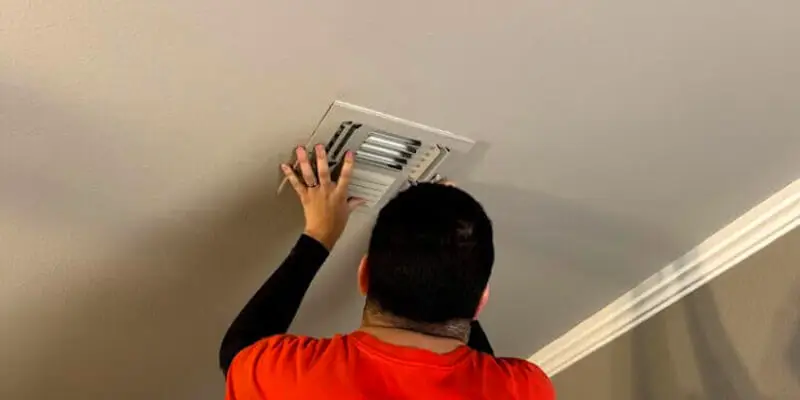
Most Houston homeowners don’t think about their air ducts. The system is hidden — metal trunks running through the attic, branch lines threading through walls and ceilings, return registers tucked behind grilles. As long as cool air comes out in July and warm air comes out the three weeks of January when we need it, it’s out of mind.
The problem is what builds up inside the ducts during all those months you’re not paying attention. Houston’s combination of humidity, year-round AC use, pollen-heavy seasons, and Gulf Coast dust does specific things to a duct system that homeowners in drier parts of the country never have to think about. Here’s what actually accumulates, why it matters, and when professional cleaning earns its keep.
What’s actually inside a Houston duct system
Take a clean white sheet of paper, hold it inside a return register, and turn the AC on. After 30 seconds you’ll have a dust map of what’s circulating through your home. The contents change with the season, but the categories stay consistent.
Dust and dander. Skin cells, fabric fibers from clothes and upholstery, pet hair, dust mites and their waste. The single largest mass of duct buildup in a typical Houston home. Most of it is benign — until it builds up enough to harbor mold or block airflow.
Pollen and outdoor particulates. Houston runs the country’s third-worst pollen levels for a reason — we have growing season nine months out of twelve. That pollen tracks in on shoes and pets, gets pulled through return ducts, and accumulates in the duct interior. Same goes for car exhaust particulates if you’re near major freeways or refineries.
Mold. The single biggest reason Houston ducts need professional attention. Our humidity averages 75 percent year-round; warm AC supply lines passing through hot attics generate condensation; over time, that condensation feeds spore colonies on duct interiors and insulation. By the time you can smell it, the colonies are visible on inspection.
Pest evidence. Roach droppings, rodent waste, dead insects pulled in from attic space. The ducts in older Houston homes (pre-1995 construction) have plenty of holes from age and previous repair work where pests get in.
Construction debris. Drywall dust, sawdust, paint chips, and insulation fibers from any renovation that happened in the home. This stuff doesn’t go away on its own — it sits at the low points of the duct system until it’s removed.
Why it matters: three real consequences for Houston homes
Indoor air quality is two to five times worse than outdoor
The EPA’s ranked indoor air pollution among the top five environmental health risks. We spend roughly 90 percent of our time indoors. Every breath you take in your home pulls air through whatever’s coating the duct interior. For a healthy adult, this usually means nothing more than the occasional sneeze. For someone with allergies, asthma, COPD, or a compromised immune system, it’s the difference between manageable symptoms and constant medication. Households with a baby, an elderly parent, or anyone going through cancer treatment have dramatically more reason to care about duct cleanliness.
Energy bills run 10 to 25 percent higher than they should
Dust buildup on the evaporator coil and inside the supply ducts increases the static pressure your blower has to push against. The motor draws more amps, the compressor cycles more often, the system runs longer to hit the thermostat target. The Department of Energy estimates that every 0.1-inch increase in static pressure raises HVAC operating costs by roughly 5 percent. A heavily contaminated duct system can hit 0.5+ inches of additional resistance — that’s 25 percent on your AC bill, every month.
Equipment lifespan drops by years, not months
HVAC blowers, compressors, and capacitors are rated for a specific operating range. Outside that range — restricted airflow, elevated coil temperatures, frequent cycling — they fail early. A clean residential AC system in Houston should last 12 to 15 years. A heavily contaminated one fails at 7 to 9. The difference is a $5,000 to $9,000 capital expense pulled forward by half a decade, all because nobody cleaned the ducts on schedule.
How often Houston homes actually need duct cleaning
The general industry recommendation is every three to five years. Houston-specific factors push that interval shorter for many homes:
Every 2 to 3 years if you have shedding pets, smokers in the home, allergies in the family, or live near a freeway or industrial corridor.
Every 3 to 5 years for an average Houston home with no pets, no smokers, no major construction in the past decade.
Immediately, regardless of last cleaning if any of these are true: visible mold around supply registers, smoke or water damage event in the home, vermin droppings in the duct interior, persistent musty smell when AC runs, or unexplained allergy symptoms that improve when you leave the house.
What professional cleaning actually involves
The phrase “duct cleaning” gets used loosely. There’s a real difference between a 30-minute job that vacuums the registers and the NADCA-aligned process that cleans the entire system end to end.
Real duct cleaning starts with negative-pressure isolation: a high-CFM truck-mounted vacuum or portable HEPA system pulls the duct system into negative pressure, so anything we dislodge during cleaning is captured into the vacuum, not pushed into your home. From there, agitation tools (rotary brushes, air whips, compressed air) work each branch line and the supply trunk. We clean the supply side, the return side, the air handler interior, the blower wheel, and (where accessible) the evaporator coil.
The job ends with photo documentation: before and after shots of the registers, ducts, blower, and coil. You see exactly what came out and what the system looks like clean. Houston jobs typically run 3 to 5 hours for a single-system home, longer for two-zone or multi-system properties.
The bottom line
Air duct cleaning isn’t maintenance theater — it’s the kind of job that visibly affects how your house feels and how much it costs to run. In Houston, where humidity, pollen, and year-round AC operation accelerate every kind of duct contamination, the maintenance interval is shorter and the consequences of skipping it are bigger than in most parts of the country.
If your last duct cleaning was more than three years ago — or if you can’t remember when it was — an inspection costs you nothing and tells you whether the system needs attention now or whether it can wait another year. Reach our Houston dispatch any time at (832) 699-0888. Twenty-plus years of cleaning ducts across greater Houston, family-owned, NADCA-aligned protocols, free in-home assessment.
Frequently asked questions
How can I tell if my Houston home actually needs duct cleaning?
Five signals: visible dust on supply registers within days of dusting, a musty smell when the AC kicks on, allergy or asthma symptoms that improve when you leave the house, energy bills that crept up without an obvious explanation, or any visible mold or pest evidence on or around the registers. If two or more of those are happening, get an inspection. Inspections are free; you only pay if you authorize the cleaning.
Is duct cleaning worth the money or is it a scam?
It’s worth the money when there’s actual contamination to remove. It’s a scam when a low-quote operator shows up with a leaf-blower-grade vacuum, runs it for 20 minutes, and charges you $69 for what amounts to dusting the registers. Real NADCA-aligned cleaning takes 3 to 5 hours, uses a high-CFM negative-pressure vacuum, and includes the supply trunk, branch lines, return ducts, blower wheel, and accessible coil. Anyone quoting under $200 for a whole-home job is doing the wrong work or skipping major parts.
How long does air duct cleaning take?
3 to 5 hours for a single-system home. Two-zone or larger homes run longer. We work room by room, set containment over registers, vacuum each branch, then move to the supply trunk and air handler. You can stay home during the work — the negative-pressure containment keeps everything inside the duct system, not in your living space.
Will duct cleaning lower my energy bill?
Usually yes, sometimes by a meaningful amount. The mechanism: dust and debris on the evaporator coil and inside ducts increases the static pressure your blower fights against, which makes the system run longer to hit the thermostat target. The Department of Energy estimates a 5 percent operating cost increase per 0.1-inch of additional static pressure. Heavily contaminated systems can hit 0.3 to 0.5 inches of extra resistance — that’s 15 to 25 percent of your AC bill, every month.
Will duct cleaning help my allergies?
For most people with seasonal or indoor allergies in Houston, yes — usually within a few days. The mechanism is removing the reservoir of pollen, dust mites, dander, and (in many cases) mold spores that’s been recirculating through the home every time the AC runs. People with severe allergies or asthma typically also benefit from upgrading to a higher MERV filter and possibly a UV-C lamp in the air handler.
What if there’s mold in my ducts?
That changes the job. Standard duct cleaning isn’t mold remediation — if we open up the system and find active mold colonies, we’ll show you the photos, give you a separate scope and quote for remediation, and you decide whether to proceed. Mold remediation involves antimicrobial treatment, removal of compromised insulation or duct sections that can’t be cleaned, and often a follow-up air quality test. We do that work in-house with proper PPE and EPA-registered chemistry.
Can I clean my own ducts?
Honest answer: not effectively. The home equipment available at retail (shop vacs, brush kits, leaf blowers) doesn’t generate the negative pressure or agitation needed to dislodge what’s actually accumulated inside the supply trunk and branches. You can dust the registers and vacuum the visible portions of return ducts — that’s a useful interim step. But a real cleaning of the system requires equipment most homeowners aren’t going to buy.
What does duct cleaning cost in Houston?
$329 to $899 for a typical residential job, depending on home size, number of HVAC systems, condition of the ducts, and whether mold remediation or coil cleaning is needed. Single-system smaller homes (under 2,000 sq ft) cluster around $329 to $549. Larger homes or multi-system jobs run $599 to $899. Anything significantly cheaper is the leaf-blower scam version. We give a flat written quote before any work starts.
How often should this be done in a Houston home?
Every 2 to 3 years if you have shedding pets, smokers in the home, allergies, or live near a freeway. Every 3 to 5 years for a typical Houston home with no pets, no smokers, and no recent renovations. Immediately, regardless of last cleaning, if you have visible mold around registers, a smoke or water damage event, vermin droppings in ducts, or persistent musty smell when the AC runs.
What areas around Houston do you serve?
The full greater Houston metro — The Woodlands, Spring, Cypress, Katy, Sugar Land, Pearland, Friendswood, League City, Pasadena, Bellaire, Memorial, Heights, Galleria, Energy Corridor. We also dispatch to Galveston, Conroe, Texas City, and Beaumont, plus into the I-10 corridor toward San Antonio. Call (832) 699-0888 with your zip and we’ll quote a response time.
When you’re ready to take care of it, here’s our air duct cleaning service for Houston homes — we’ll tell you straight whether you actually need it.
Do you also clean dryer vents? Yes — and it’s worth asking. Dryer vents and air ducts are separate systems, but a lint-clogged dryer vent is both an efficiency drain and a real fire risk, especially in our humid climate where damp lint packs together fast. It’s one of the most common add-ons Houston homeowners ask about alongside ductwork; you can read more about our dryer vent cleaning service.