Keep your building’s air clean and healthy for every tenant
Sick Building Syndrome (SBS) describes a pattern where people in the same building start feeling worse than they should — and start feeling better when they leave. The symptoms are real, but the cause isn’t always one specific contaminant. It’s usually a mix of dust, mold, bacteria, poor circulation, off-gassing from materials, and humidity issues that compound over time.
For Houston commercial property owners and managers, this isn’t a niche concern. Our climate makes the conditions for SBS more common: long cooling seasons, high humidity, dense urban buildings that recirculate air, and an older commercial stock that often runs HVAC equipment well past its prime. When tenants complain about headaches, sinus issues, or fatigue that follows them into the office and not back home, the building itself is worth investigating.
The symptoms to watch for
SBS shares a lot of overlap with common colds, flu, and allergies, which is part of why it goes undiagnosed. The key tell is the
pattern: multiple people, same building, symptoms ease on weekends and vacations, return when they come back to work.
- Headaches that build through the workday
- Coughing, sneezing, or persistent throat clearing
- Itchy eyes, runny nose, scratchy throat
- Skin rashes or irritation
- Nausea and fatigue
- Difficulty concentrating, brain fog
- Dizziness, especially after extended time in the building
If the same set of complaints is showing up across departments or floors, that’s worth taking seriously. One person feeling sick is medical. Five people in the same wing feeling the same way is environmental.
Why Houston commercial buildings face above-average risk
A few things about Houston make SBS more likely than in drier or cooler markets:
Year-round AC dependence. Most Houston offices run cooling for nine or ten months a year. That’s a lot of air cycling through the same ducts, the same filters, the same coils. Anything that builds up — dust, mold spores, organic debris — gets distributed and redistributed.
High humidity. When indoor humidity drifts above 60%, mold and dust mites thrive. Older HVAC systems often can’t pull humidity down enough during the shoulder seasons, and the ducts themselves can develop microbial growth in the dampest sections.
Storm and flood aftermath. Hurricanes and heavy rain events leave their mark inside HVAC systems. Standing water in plenums or near air handlers becomes a long-term mold source even after the visible damage has been repaired.
Older inner-loop building stock. A lot of commercial space in the Galleria, Greenspoint, Westchase, and downtown areas runs HVAC equipment that’s 20, 30, sometimes 40 years old. The fundamentals — ductwork, registers, coils — often haven’t been touched in decades.
How HVAC drives air quality, for better or worse
Your HVAC system is the circulatory system of the building. Whatever’s in the ducts ends up in the breathing space of every person inside. Several things commonly go wrong:
- Dirty filters. Filters in commercial settings often go ignored. A clogged filter doesn’t just stop catching new debris — it starts releasing some of what it’s already trapped.
- Coil contamination. Evaporator coils condense moisture out of the air. When they’re coated in dust, that dust becomes a wet substrate for bacterial and fungal growth.
- Drain pan issues. Slow-draining or stagnant condensate pans become microbial colonies. The smell, sometimes called dirty sock syndrome, is a giveaway.
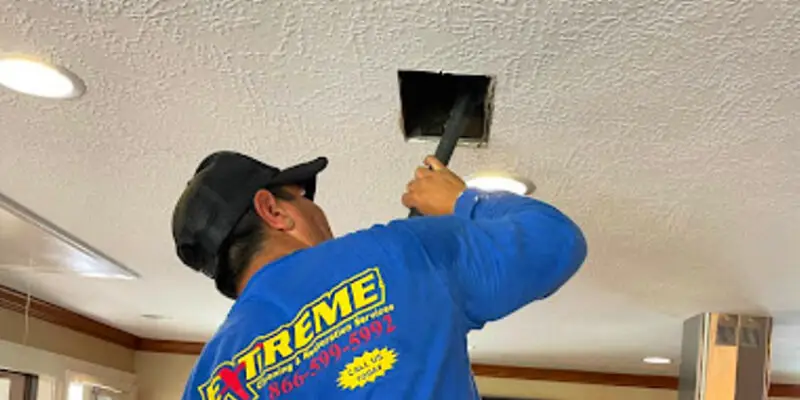
- Duct buildup. Years of dust and biological debris accumulate inside the ductwork. Every gust of supply air picks some of it up.
- Insufficient outside air. Buildings tightly sealed for energy efficiency can starve themselves of fresh air, letting CO2 and VOCs accumulate.
Most of these problems stay invisible until they’re acute. They show up as headaches and sniffles long before they show up on a maintenance report.
Six steps that genuinely reduce SBS risk
If you manage a Houston commercial property — office, medical, retail, multi-tenant — here’s where the real wins are:
1. Schedule professional duct cleaning on a real interval. NADCA recommends every two to three years for commercial spaces, sooner if there’s been water damage or renovation.
Commercial air duct cleaning isn’t the same as residential. The equipment, scope, and contamination patterns are different. Don’t let a residential crew try to handle a 50,000-square-foot office.
2. Replace filters on a calendar, not a feel. Monthly during peak cooling season for most Houston commercial settings. MERV 11 or higher captures the particles that matter for indoor air quality without choking airflow.
3. Get coils, drain pans, and blower assemblies inspected annually. A real visual inspection means opening the access panels and looking inside. If there’s biological growth on the coils, no amount of duct cleaning alone will solve it.
4. Address visible mold the day you find it. Mold doesn’t get smaller on its own. If a leak shows up over a ceiling tile, the HVAC components above that tile need to be inspected too.
5. Manage humidity to 40-60%. Standalone dehumidifiers, properly sized AC equipment, and good envelope sealing all matter. In Houston specifically, oversized AC units (a common mistake) actually make humidity
worse because they short-cycle without dehumidifying.
6. Bring in fresh air on a schedule. Many older buildings have outside-air dampers that have been closed off for years to save energy. Reopening them, even partially, does more for SBS than any plug-in air purifier.
When to bring in a professional
If any of the following are happening, it’s time to stop guessing and get a professional inspection:
- Multiple tenants on the same floor reporting similar symptoms
- Visible mold inside HVAC equipment or on supply registers
- Persistent musty or chemical smells when the AC starts up
- Recent water damage, even if it looked minor at the time
- Recent renovation that involved sealing materials, paints, or new flooring
- HVAC equipment that hasn’t been touched in five or more years
A licensed Houston commercial duct cleaning company can inspect the system, document what they find, and give you a remediation plan that addresses the source rather than just the symptoms.
Frequently asked questions
How long do Sick Building Syndrome symptoms last after exposure?
Symptoms typically ease within hours of leaving the building. That’s part of how SBS gets identified — people feel fine on weekends and worse during the work week. Chronic exposure can lead to longer-lasting issues, especially for people with asthma or pre-existing respiratory conditions.
Can SBS be measured directly?
Not in a single test. Indoor air quality assessments measure CO2, VOCs, particulates, humidity, and microbial counts. Combine those readings with a tenant symptom survey and a physical HVAC inspection, and the picture usually becomes clear.
Does air duct cleaning fix Sick Building Syndrome?
It addresses one of the most common contributing factors, but not always all of them. Duct cleaning removes the accumulated contamination inside the system. If the source is also coil growth, drain pan biofilm, or insufficient outside air, those need to be addressed too. A good commercial cleaning service inspects the whole system, not just the ducts.
What’s the difference between SBS and Building-Related Illness?
SBS describes symptoms tied to a building when no specific cause has been confirmed. Building-Related Illness (BRI) is when a specific source has been identified, like Legionnaires’ disease from cooling tower bacteria or hypersensitivity pneumonitis from a specific mold strain. SBS often becomes BRI once the diagnostic work is complete.
How often should commercial HVAC be inspected in Houston?
At minimum, annually. For buildings with sensitive occupancy, like medical offices, schools, and multi-tenant offices, quarterly visual checks of filters, coils, and condensate systems make sense. Full duct cleaning every 2-3 years is a reasonable baseline; sooner if there’s been water damage, smoke, construction debris, or persistent IAQ complaints.
Bottom line
Sick Building Syndrome isn’t a mystery condition. It’s the cumulative result of small things being neglected for a long time: filters, coils, ducts, drain pans, fresh-air intake. Get those working properly and the headaches and brain fog usually fade.
If your Houston commercial building is showing the warning signs, our
commercial air duct cleaning team can inspect the system, document what’s there, and clean what needs cleaning. Call (832) 699-0888.